The Market Data API and the Sheets add-on offer four option pricing models for historical implied volatility (IV) and Greeks: Black-Scholes-Merton (bsm), Bjerksund-Stensland (bjs), Cox-Ross-Rubinstein (crr) and Barone-Adesi-Whaley (baw). On a paid plan, you pick one with the model parameter. Each model can give a different IV for the same option at the same price.
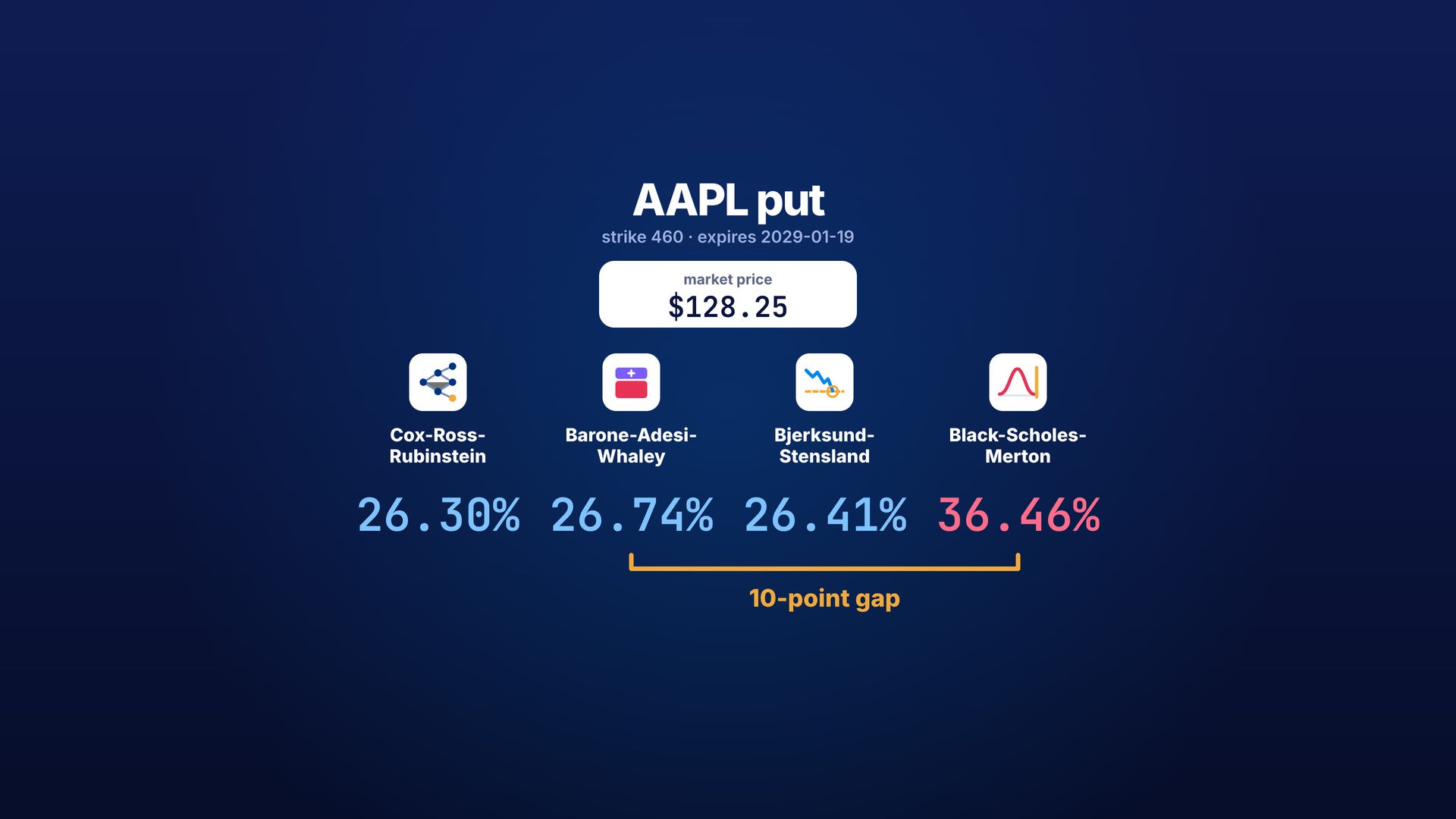
Take a deep in-the-money Apple put that expires in more than two years: bjs, crr and baw agree within half a point, and bsm comes out about ten points higher. None of them is wrong. Each model makes different assumptions, so the question isn’t “which model is right?” It’s “which model gave you that number, and which one do you want to compare with?”
Why does the model change the IV?
Implied volatility is the volatility that makes a model’s price equal the market price. The market gives you the price; the model gives you the volatility. Change the model, and you change the volatility it needs to reach that price. The Greeks change with it, because every Greek comes from the same model.
Our four option pricing models
You can pick any of these four in the API and in Google Sheets.
| Model | Name in the API and Sheets | How it handles early exercise |
|---|---|---|
| Black-Scholes-Merton | bsm | It doesn’t. It assumes exercise only at expiration, like a European-style option. |
| Bjerksund-Stensland | bjs | It sets one trigger price and exercises as soon as the stock reaches it. |
| Cox-Ross-Rubinstein | crr | A binomial tree of 100 price steps. At each step, it checks whether exercising beats holding. |
| Barone-Adesi-Whaley | baw | The European price plus a premium for exercising early, from a quadratic approximation. |
Without model, American-style contracts get bjs and European-style contracts get bsm.
European-style options always get bsm
European-style options can’t be exercised early, so bsm is the exact model for them. That’s why we never price them with an American model: they always get bsm, even if you pick another model. We don’t block the other way around. If you want bsm on American-style options, to compare with a broker that uses it for everything, that’s your call.
Where our models differ
Here are four Apple puts from one trading day (October 5, 2026, with the stock at $332.89):
- One week out, at the money: all four models land within about a tenth of a point.
- One week out, deep in the money:
bsmcomes out about five points higher than the other three. - Over two years out, at the money:
bsmis already one to two points higher. - Over two years out, deep in the money:
bsmcomes out about ten points higher, and the other three agree within half a point.
On the last put, delta disagrees too: bsm says just over -0.5, the others almost -0.9.
Why? You can exercise an American put right away, so it’s worth at least the strike minus the stock price. Take the last put: the strike is $460 and the stock is at $332.89, so exercising pays $127.11 at once. The put trades at $128.25, only $1.14 more. bsm assumes you wait until expiration, and waiting costs interest. So it prices the put lower, and it needs more volatility to reach the market price. The deeper in the money and the longer the put, the bigger the gap.
How to pick one of our models
It’s your call. Our recommendation: pick the model that matches the numbers you compare with, and if you have nothing to compare with, keep the default.
- Comparing with your broker or data vendor? Pick the model they use. If they use a binomial tree, pick
crr. If they use a quadratic approximation, pickbaw. - Comparing with Black-Scholes-Merton numbers? Some brokers and data vendors use it for everything, even on American-style options, where its IV runs high on deep, long-dated puts. Pick
bsm. - Still a gap with the same model? The interest rate, the carry, the time to expiration and the stock price can differ too. Our article on why IV and Greeks differ between brokers explains those inputs.
- Following a contract over time? Use the same model on every date, so today’s IV compares with last month’s.
- Not sure? Leave out
model, and you get the default.
An easy mistake is to compare a vendor’s bsm IV with our default bjs IV. On the last put above, the model alone makes a gap of about ten points, which looks like bad data. Pick bsm before you compare.
How to pick a model in the API and in Google Sheets
Every Market Data plan includes historical IV and Greeks, the free plan too. They use the default models. On a paid plan, you can pick the model of a historical request. Want to compare models on your own contracts? Sign up at Market Data and run the same request with each model.
API: add model to a historical request of the option chain endpoint (with date) or the option quotes endpoint (with date, or from and to):
GET https://api.marketdata.app/v1/options/quotes/AAPL290119P00460000/?date=2026-10-05&model=bsmGoogle Sheets: add the model name to the attributes of OPTIONDATA (with a start date) or OPTIONCHAIN (with an “as of” date):
=OPTIONDATA("AAPL290119P00460000", "mid,iv,delta,bsm", "10/05/2026")
=OPTIONCHAIN("AAPL", "strike,mid,iv,delta,crr", "11/20/2026", "limit 6", "puts", "10/05/2026")
Other option pricing models
Brokers, data vendors and researchers use more models than our four. Market Data doesn’t support them yet. If you need one, calculate it yourself from our option prices and the stock price, with your own interest rate and dividend inputs. Some you’ll meet:
- Other trees and grids: binomial trees with more steps or another layout, such as Leisen-Reimer, and finite-difference grids. Our
crris one tree with 100 steps. - Other early-exercise approximations: newer quadratic methods, such as Ju’s and QD+, and the 2002 version of Bjerksund-Stensland. Our
bjsis the 1993 version. - Stochastic volatility models, such as Heston, where volatility itself moves. They fit the whole volatility surface at once, so they don’t give one IV per contract in the usual way.
- Local volatility models, such as Dupire’s, where volatility depends on the stock price and time.
- Monte Carlo simulation, which prices an option over many random price paths.
Our article on why IV and Greeks differ between brokers says more about several of them.